
Breaking Through Rubisco’s Bottleneck: New Platform Reveals Promising Ancestral Enzymes

Photosynthesis feeds the world, but it’s not as efficient as it could be. The enzyme Rubisco, responsible for capturing carbon dioxide from the air, is notoriously slow and often struggles to distinguish between carbon dioxide and oxygen, creating a major drag on crop productivity. Scientists have long sought to improve Rubisco, but testing new versions of the enzyme in living plants has been very difficult—the native enzyme gets in the way.
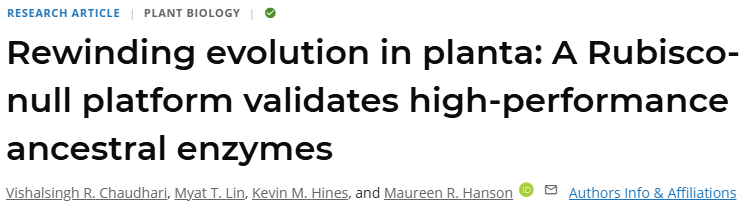
In a new study published in PNAS, our lab solved this problem by creating a tobacco platform that completely lacks native Rubisco. Using CRISPR-Cas9, the team knocked out all 11 genes encoding the small subunit of Rubisco, while keeping plants alive with a backup cyanobacterial version of the enzyme expressed in the chloroplast.
This Rubisco-null platform provides a “clean slate,” allowing us to test new enzyme variants in a living plant without any interference from native proteins. We used this platform to test something remarkable: ancestral Rubiscos. These are “resurrected” ancestors of the Rubisco that date back to eras with higher temperatures and carbon dioxide levels. Our lab previously resurrected these enzymes in E. coli system and found them to be functional and kinetically superior. With the plant system developed in this study, we were able to test these ancestral rubiscos in planta, without native rubiscos muddying the analysis. These “resurrected” ancestral enzymes weren’t just functional—they were faster and more efficient than modern versions, showing 16-20% higher catalytic efficiency under normal atmospheric conditions.
The key to their superior performance? These ancient enzymes work faster, processing carbon dioxide at a significantly higher rate than their modern descendants and are better adapted for higher temperatures and ambient carbon dioxide. The transgenic plants expressing these ancestral Rubiscos appeared completely normal and produced enzyme levels comparable to those of regular tobacco plants.
Improving Rubisco is a “holy grail” of plant science. A more efficient Rubisco means crops could potentially grow faster with less nitrogen and better water-use efficiency. This work establishes ancestral reconstruction as a promising strategy for finding better Rubiscos and provides researchers with a powerful new tool for testing photosynthetic improvements. With crop yields struggling to keep pace with global food demands, unlocking Rubisco’s potential could be crucial for feeding the future.
Congratulations to Dr. Gipson

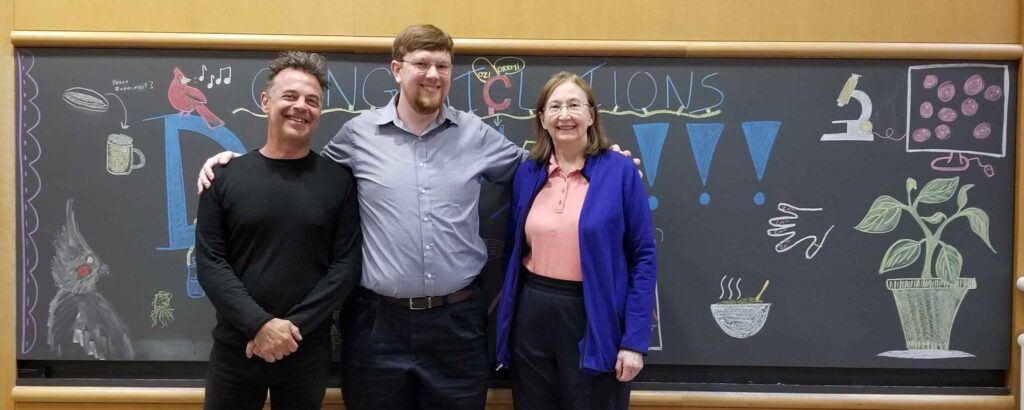
Stephane Bentolila, Andrew Gipson, and Maureen Hanson at the celebration of Andrew’s successful completion of his Ph.D. exam, July 2021

Andrew Gipson’s Cornell career started with an NSF REU BTI/Cornell internship in the Hanson lab, where he won the “Colonel’s Cup” for best research presentation.  After graduating from Kenyon College and working at U. Minnesota as a technician, Andrew returned to Cornell and completed his Ph.D. on plant organelle organelle editing, co-advised by Stephane Bentolila and Maureen Hanson.  Andrew has become an accomplished teacher, holding several head TA positions.  Andrew presented his work at a minisymposium at the 2020 online ASPB meeting. He is co-author of a paper on an RNA splicing factor.   With the publication of a review article, Andrew is officially an expert in zinc finger proteins in plants!


Hanson elected to two Academies

Dr. Maureen Hanson has been elected to two important organizations in April 2021.

On April 22, the American Academy of Arts and Sciences announced their 2021 election results. A total of 252 new members were elected. Hanson joins other newly elected members Oprah Winfrey (Harpo, Inc.; Oprah Winfrey Network), Sanjay K. Gupta (CNN; Emory University School of Medicine), and H. Holden Thorp (American Association for the Advancement of Science). The Cornell Chronicle has featured Hanson’s election in a recent article.

Shortly after, on April 26, the National Academy of Sciences released their list of 120 newly elected members. Hanson joins a renowned group of national and international scientists.  Members are elected based on “their distinguished and continuing achievements in original research.” Election to the NAS is one of the highest honors in the scientific field.  The Cornell Chronicle has a second article featuring two faculty from Cornell who were elected this year.


Plasma proteomics publication shows disrupted cell-to-cell signaling

We are proud to announce our latest plasma proteomics publication is available as open access in Proteomes.

This manuscript takes a look at 4,790 circulating plasma proteins from 20 ME/CFS women compared to 20 healthy women, over an unprecedented range, for ME/CFS, of 9 orders of magnitude.

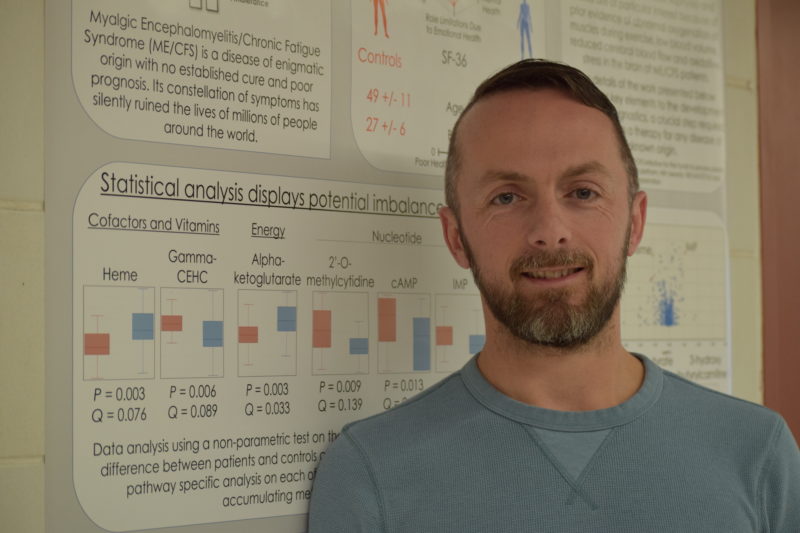
Arnaud Germain, PhD

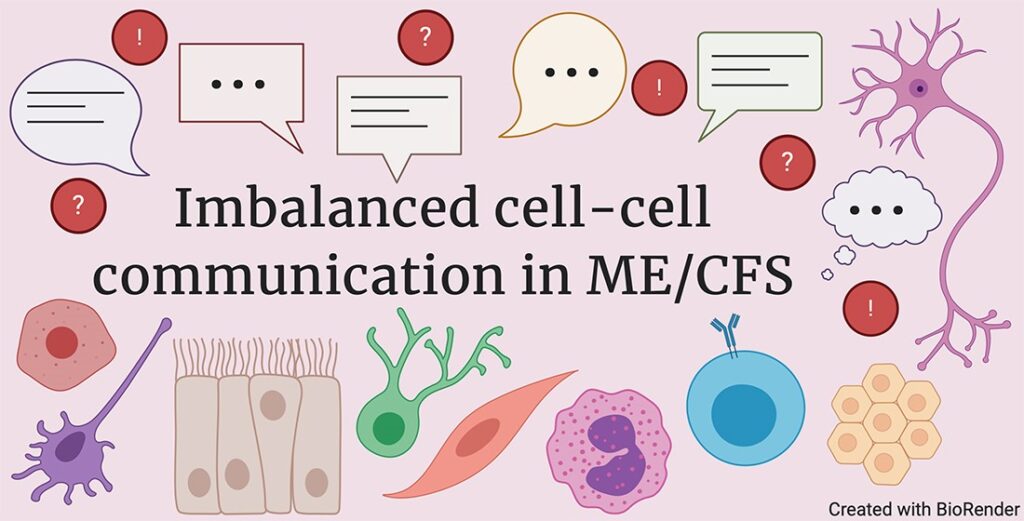
Pathway analysis uncovered disrupted cell-to-cell communication, specifically in the ephrin-Eph signaling pathway. This pathway is crucial for many aspects of our body’s homeostasis, including development, physiology, and disease regulation.

Additionally, the paper outlines promising results for the development of a diagnostic test using protein ratios.

First author, Arnaud Germain, PhD, outlines these findings in a video abstract below.

Transcripts for the video are available:
English
German

Chinese, French, and Spanish subtitles for the video abstract are available. See video settings to select an option.


Congratulations to Kevin Hines

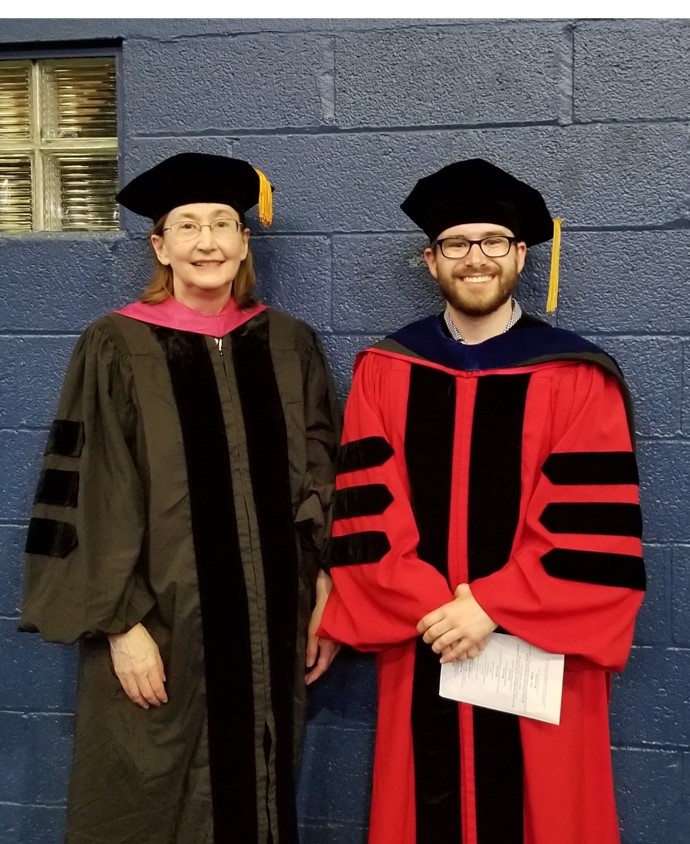
Dr. Maureen Hanson and Dr. Kevin Hines at the Cornell hooding ceremony

From an REU internship to a Ph.D., Kevin Hines has made a notable impact on the Hanson Lab. His journey in the Hanson Lab started in 2012 as an NSF REU summer intern. This internship involved developing genetic tools for the production of carboxysomes in tobacco chloroplasts. His work proved fruitful contributing to a publication in Plant Journal.

After his internship, Hines decided to continue his research efforts at Cornell and joined the Hanson Lab as a graduate student. Building off of his previous work, Hines developed an aptitude for microscopy where he collaborated in the publication of articles on stromules, RNA editing, and carboxysomes (under review). His skilled application of scientific techniques enabled him to explore a thesis regarding carbonic anhydrase in plant chloroplasts. Cornell’s OVPR highlighted this work in an article.

His time in the lab included participating in the ASPB meeting and the Photosynthesis from Light to Life conference in 2018. In that same year, he also presented at the International Symposium on Photosynthesis and Chloroplast in Kurashiki, Japan. All of this work came together on November 20, 2019 when he successfully defended his thesis. Congratulations, Dr. Hines!


Congratulations to Alexandra Mandarano

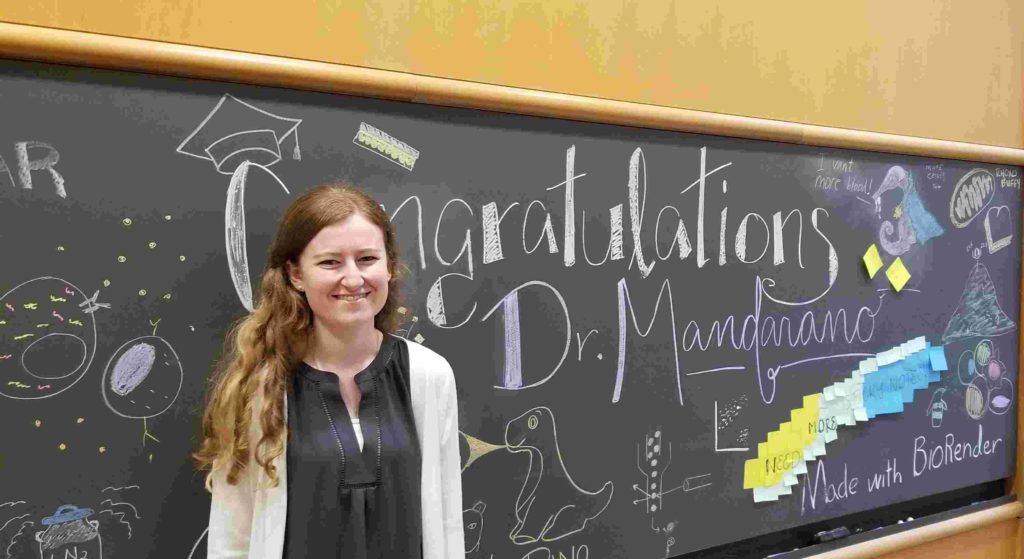
Dr. Alexandra Mandarano

The Hanson Lab would like to congratulate Alexandra Mandarano on passing her Ph.D. thesis exam on July 19, 2019. Mandarano joined the Hanson Lab after completing a B.S. in Biochemistry from SUNY-Geneseo. In the lab, her work focused on the gut microbiome and immune cell metabolism in ME/CFS. This work is highlighted in a microbiome publication in PeerJ and a T cell metabolism publication in the Journal of Clinical Investigation. The latter of which also has an accompany video.

Her time in the lab included participating in several conferences and meetings. One of these events, the NIH Accelerating Research on ME/CFS meeting in 2019, she presented her work along with other key speakers. She also received a travel scholarship to attend an ME/CFS conference in London. Since graduating, Mandarano has started a postdoctoral position at the St. Jude’s Children’s Hospital in Memphis, Tennessee. Congratulations, Dr. Mandarano!


Scroll to top